
In mid-July 2026, a new term started gaining real traction in the AI and agent-building community: Graph Engineering.
It describes the practice of designing multi-agent and complex AI systems as explicit graphs instead of relying on a single agent running one continuous loop.
Core Idea
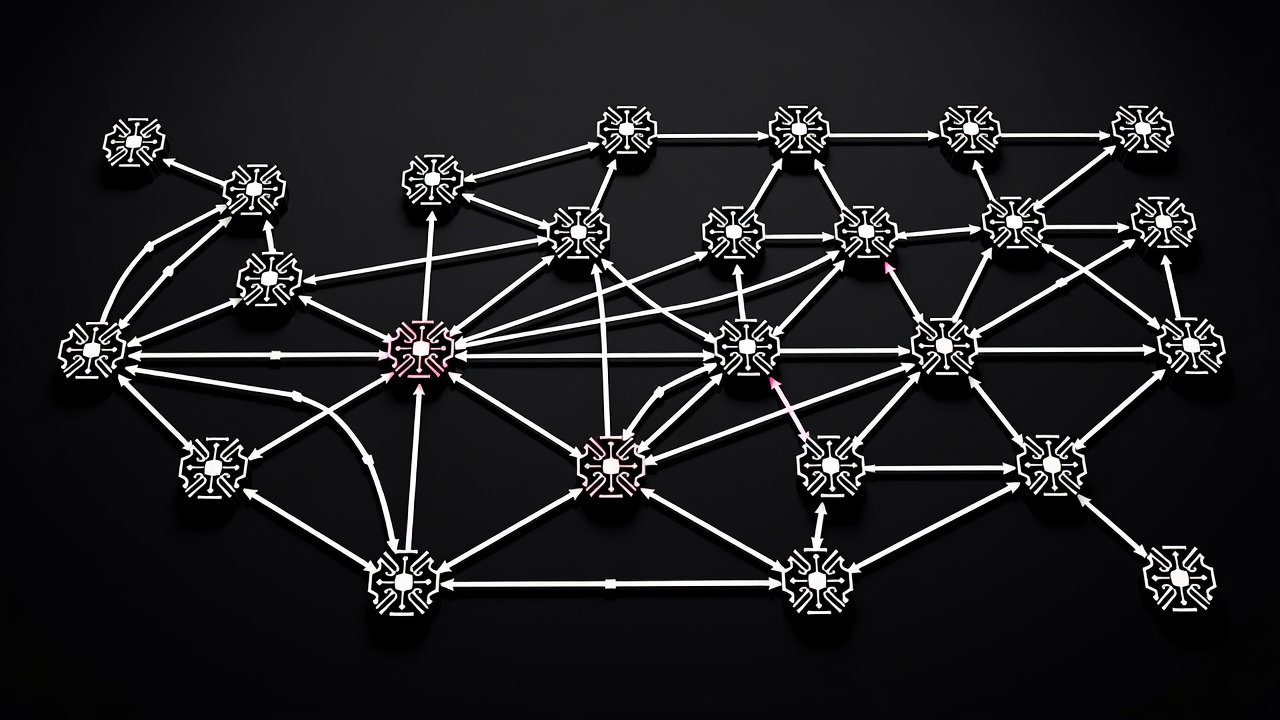
Think of the system as a directed graph:
- Nodes are specialized agents, deterministic functions or tools, routers, human checkpoints, evaluators, or discrete steps (researcher, writer, reviewer, security agent, etc.).
- Edges define routing, communication, delegation, dependencies, branching, fan-out/fan-in, retries, and control flow between those nodes.
- Shared state travels along the edges instead of living only inside one agent’s context window.
The topology itself—who exists, what each component owns, who can talk to whom, and how work gets routed—becomes a programmable, versionable, and inspectable artifact.
Loop Engineering vs Graph Engineering
Loop engineering focuses on perfecting a single agent’s cycle: observe → plan → act → verify → repeat.
Graph engineering is the next layer up. It’s about composing multiple loops (or mixed agent + code nodes) into a larger directed graph when one loop is no longer enough.
A single loop is essentially a graph with one node and a self-edge. Most simple tasks still only need a well-designed loop. Graphs become valuable when you need parallelism, independent verification, specialized roles, human-in-the-loop gates, or complex dependency management.
Two Related but Distinct Meanings
The term is currently used in two overlapping ways:
-
Multi-agent orchestration graphs (the dominant 2026 usage)
Designing the structure of agent teams and organizations — roles, mandates, message paths, and failure handling. Frameworks like LangGraph are frequently referenced here. -
Knowledge / memory graphs (an older but related practice)
Storing knowledge as typed entities and relationships so agents can traverse and reason over structure instead of relying purely on similarity search. This connects to GraphRAG and agent memory systems like Graphiti.
These two approaches can (and often do) coexist in the same system.
Why This Matters
Single long-running agent loops struggle with reliability, state management, specialization, and auditability at scale. Explicit graphs make the control flow, ownership boundaries, and failure modes visible and engineerable.
It moves us closer to traditional workflow and orchestration systems, but with probabilistic agent nodes instead of purely deterministic ones.
The underlying practices — orchestration graphs, stateful workflows, and knowledge graphs — predate the buzzword. What’s new is the label itself, and the community’s growing recognition that treating these topologies as first-class engineering artifacts is necessary for building reliable, production-grade agent systems.
Bottom line: Graph Engineering is currently the community’s name for taking multi-agent and multi-step AI systems seriously as engineered topologies rather than emergent chat loops.